


Learner and Third‑Party Complaints Policy
- Purpose and Scope
Cambrian Training Company (CTC) is committed to providing high‑quality apprenticeship training and support. This policy ensures that all learners and third‑party individuals can raise concerns, have them addressed fairly and promptly, and understand how their complaint will be managed.
This policy applies to:
- All apprenticeship learners
- Employers and workplace mentors
- Parents/carers (where applicable)
- Any third party affected by CTC’s operational activities
- Former apprenticeship learners
- Definitions
2.1 What is a Complaint?
A complaint is an expression of dissatisfaction about:
- The quality or delivery of training
- Conduct or behaviour of CTC staff
- Policies, processes, or decisions
- Communication or administrative issues
- Treatment experienced as part of operational activities
2.2 What is not a Complaint?
- Appeals against assessment decisions (covered by the separate Appeals Procedure)
- Requests for information
- Employer‑led HR matters
- Issues outside CTC’s control (e.g., employer contractual disputes)
- Levels of Complaint
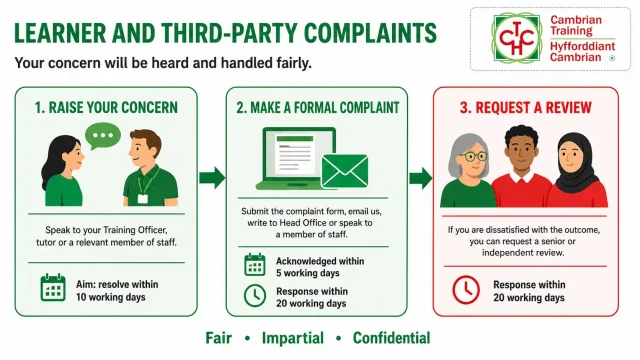
Level 1 – Informal Resolution (Local Level)
Handled by: Training Officer/Tutor or relevant staff member
Timescale: Within 10 working days
Examples:
- Miscommunication
- Minor dissatisfaction with session delivery
- Early‑stage concerns
The member of staff must inform their line manager of the informal complaint, and it must be logged within the learner management system.
Level 2 – Formal Complaint
Handled by: Head of Business Unit / Director of Quality & Skills
Timescale: Acknowledgement within 5 working days; response within 20 working days
Examples:
- Failure to resolve at Level 1
- Concerns about staff conduct
- Repeated service failures
- Issues requiring investigation
This must be reported on the monthly return log by all business units
Level 3 – Senior Review / Independent Review
Handled by: CTC Director / Independent Reviewer
Timescale: 20 working days
Examples:
- Serious or complex complaints
- Allegations of discrimination, safeguarding, or systemic failure
- Dissatisfaction with Level 2 outcome
This must be reported on the CTC Board of Directors.
- Medr Regulatory Requirements
4.1 Making the Procedure Known
Medr requires providers to take reasonable steps to ensure learners know how to complain. CTC will:
- Provide the policy at induction
- Publish it on the website
- Include it in learner handbooks
- Ensure staff can explain the process clearly
- Reportable Events
Some complaints may indicate a Reportable Event under Medr’s regulatory framework. CTC will assess all complaints to determine whether they meet the threshold for reporting.
5.1 What Complaints May Trigger a Reportable Event?
Examples include (but are not limited to):
Serious Incidents
- Safeguarding concerns
- Significant harm to a learner
- Data breaches affecting learners
- Legal action against CTC
- Systemic governance failures
Notifiable Events
- Senior leadership changes
- Major operational disruption
- Loss of key delivery partners
- Issues affecting learner continuation
- Complaint Handling Process
6.1 Time constraints
Complaints should normally be raised within 3 months of the issue occurring or the learner becoming aware of the matter.
This time limit applies to current and former apprenticeship learners.
However, CTC will apply this requirement flexibly where there is a valid reason for delay, including (but not limited to):
- health or wellbeing circumstances
- ongoing attempts to resolve the issue informally
- lack of awareness of the complaints procedure
- complex or sensitive matters
Each case will be considered on its individual merits to ensure fairness.
6.2 Submission
Complaints may be submitted:
- Via the official complaint form ( annex
- By email
- In writing to Head Office
- Verbally (with written confirmation recorded by staff)
6.3 Acknowledgement
CTC will acknowledge all formal complaints within 5 working days.
6.4 Investigation
Investigations will be:
- Fair, impartial, and evidence‑based
- Conducted by staff not previously involved
- Completed within published timescales
6.5 Outcomes
Learners will receive:
- A written response
- Findings and rationale
- Any actions taken
- Information on next steps or escalation
- Escalation Beyond CTC
Only if all internal stages are exhausted, learners may escalate externally.
Learners are then entitled to refer their complaint to Medr by written submission or to the relevant external body such as Education Workforce Council, Awarding Body via their complaint’s procedure
- Governance, Monitoring and Continuous Improvement
All complaints, whether informal or formal, will be accurately recorded and securely stored in line with CTC’s Data Protection Policy.
- Central Recording System:
All complaints will be logged within the central learner management system to ensure consistency, traceability, and effective oversight across the organisation. - Individual Records:
A record of each complaint, including correspondence, investigation notes, and outcomes, will be retained:- On the relevant individual learner or third-party file, where applicable
- On the file of any member of staff involved, where the complaint relates to staff conduct or performance
- Monitoring and Reporting:
Complaint data will be:- Reviewed regularly by senior management
- Included within monthly returns (where applicable)
- Reported to the CTC Board of Directors, including trends, themes, and any actions taken
- Purpose of Recording:
Records will be used to:
- Analyse trends for quality improvement
-
- Ensure transparency and accountability
- Support quality improvement and service enhancement
- Identify recurring issues or risks
- Meet regulatory and governance requirements
Retention:
All complaint records will be retained in accordance with CTC’s data retention schedule and applicable regulatory requirements.
- Links to Other Policies
- Appeals Procedure
- Safeguarding Policy
- Learner Protection Plan
- Equality & Diversity Policy
- Data Protection Policy
- Education Workforce Council Complaints Policy
- Awarding Body Complaints Policy
- Whistleblowing policy