
Purpose and Strategic Context
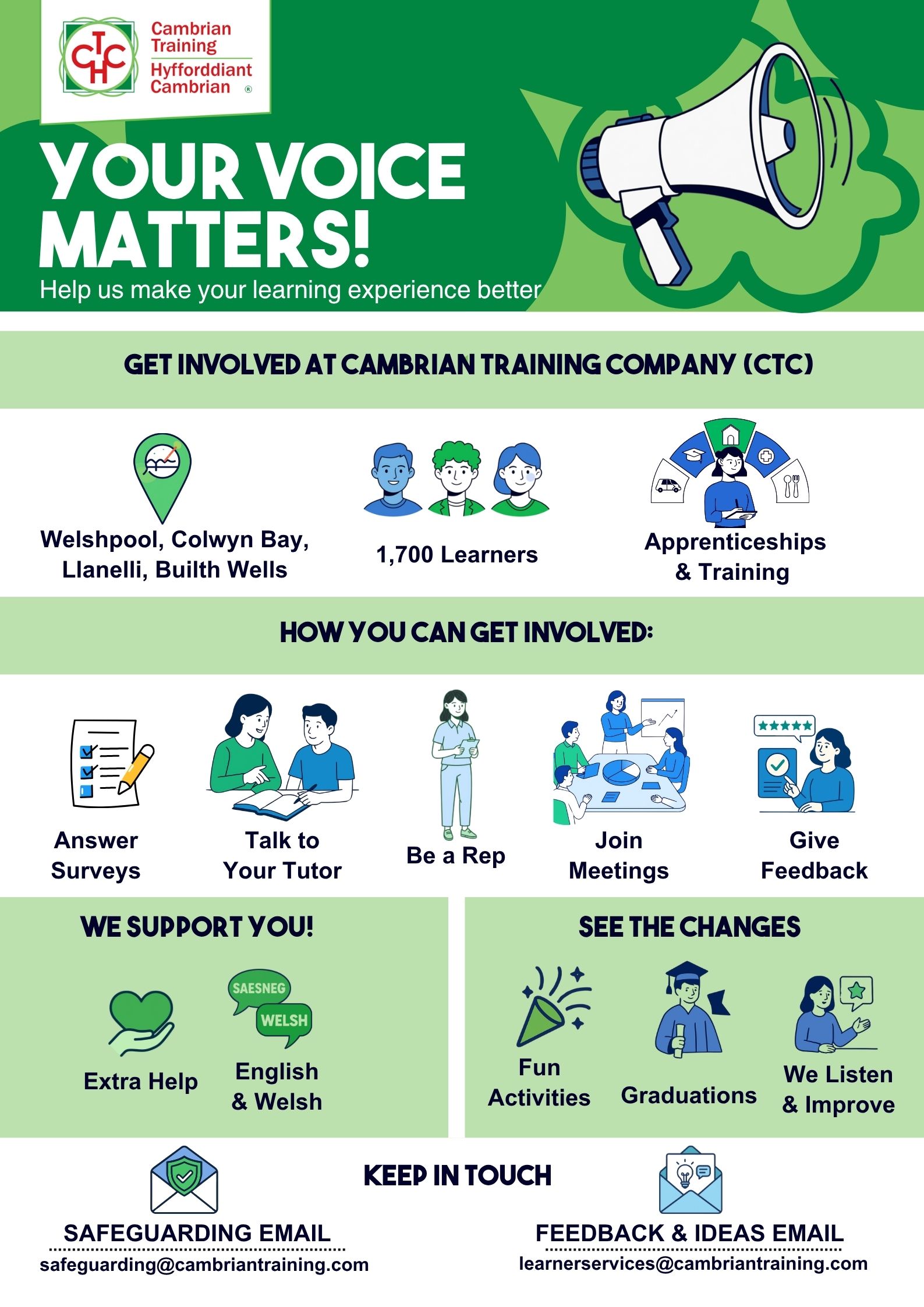
This strategy sets out how CTC & Subcontractors will ensure that learners are actively involved in shaping, influencing, and evaluating their learning experience, in line with Medr’s regulatory expectations.
The strategy ensures:
- Learners are represented in decision-making
- Learners have opportunities to participate and provide feedback
- Learner voice is acted upon to drive continuous improvement
- Learner engagement is recognised as a core component of quality assurance, governance, and continuous improvement, and is integral to Estyn inspection expectations.
Context for Work-Based Learning
Engaging learners within CTC’s provision presents a distinctive challenge due to the nature of work-based learning and the variability of learner experiences across employers, sectors and programmes.
All learners are based in workplace settings, where day-to-day experiences are shaped primarily by their employer environment. Delivery models, training officer contact and programme requirements can vary across programmes and subcontractors. His means that learners do not experience a standard ‘provider-led’ environment, making it more difficult to implement standardised approaches.
These factors can impact:
- Learner availability to engage
- Consistency of participation across provision
As a result our learner engagement strategy addresses the need to be:
- Flexible and proportionate to employer and learner circumstances
- Integrated into existing touchpoints (e.g. training officer reviews rather than additional structures
- Realistic in expectations recognising limitations on learner time and access
This context underpins the approach set out in this strategy ensuring that engagement mechanisms are practical, inclusive and capable of operating effectively across a diverse and distributed learner population
Strategic Aims
- Embed learner voice at all organisational levels
- Strengthen learner partnership in decision-making
- Ensure inclusive and accessible engagement mechanisms
- Demonstrate measurable impact from learner input
- Align engagement activity to Medr Quality Framework and regulatory conditions
Principles for Learner Engagement
This strategy is structured around Medr principles:
| Principle | Strategic Interpretation |
| 1. Embedded | Learner engagement is integrated into governance, curriculum, and quality cycles |
| 2. Valued | Learner contributions are respected and visibly influence decisions |
| 3. Understood | Learners understand their role and how to engage effectively |
| 4. Inclusive | Engagement reflects the diversity of the learner population |
| 5. Bilingual | Opportunities are available in Welsh and English |
| 6. Individual & Collective | Engagement includes individual feedback and collective representation |
| 7. Impactful | Engagement leads to demonstrable change |
| 8. Resourced | Adequate staffing, systems, and time are allocated |
| 9. Evaluated | Activity is measured and reviewed regularly |
Objective: Ensure learners are active partners in decision-making
Actions:
- Learner Voice Surveys
- Comprehensive Learner Training & Induction
- Pulse Surveys
- Comprehensive monthly feedback reviews
- Employer feedback
- Ensure all learners can participate meaningfully e.g. ALN learners
- Provide flexible engagement formats
- Ensure bilingual engagement opportunities
- Monitor participation across protected characteristics and provider types
- Introduce “You Said, We Did” communication cycle through newsletters
- Ensure feedback loops are closed within defined timescales
Measurement and Evaluation Framework
| Measure | Indicator |
| Participation | % of learners engaging in feedback activities |
| Representation | Number of active learner reps across sectors/providers |
| Responsiveness | % of feedback responded to within agreed timeframe |
| Impact | Evidence of changes made from learner feedback |
| Satisfaction | Learner perception of being listened to |
- Engagement activity will be reviewed quarterly
- Impact will be reported annually to the Board
- Approach will align with Medr monitoring expectations
Risks and Mitigation
| Risk | Mitigation |
| Low learner participation | Diversify engagement methods; incentivise participation |
| Tokenistic engagement | Strengthen governance links and accountability |
| Inconsistent practice across providers | Standardise expectations and monitoring |
| Lack of visible impact | Strengthen “You Said, We Did” reporting |
This strategy provides assurance that:
- Learner voice is systematically embedded across all provision
- Learners are actively involved in shaping their experience
- Engagement is inclusive, measurable, and impactful
- The organisation is fully aligned to Medr’s Learner Engagement Code and quality expectations